Scope the code
Build import and call maps, identify attacker inputs, then give each investigation only the relevant code.
For validator, consensus, and cryptographic teams: vigilX searches beyond a single AI pass, tests whether an attacker can reach the path, and delivers exploits your engineers can replay.




An independent Solana validator client, researched under a competition that required runnable proofs for reported issues.
Three High, one Low. The hidden account and report names prevent independent attribution.
Solana client written in C.
Competition brief's stated codebase size.
Listed across awards; payout depended on findings.
Required for every severity.
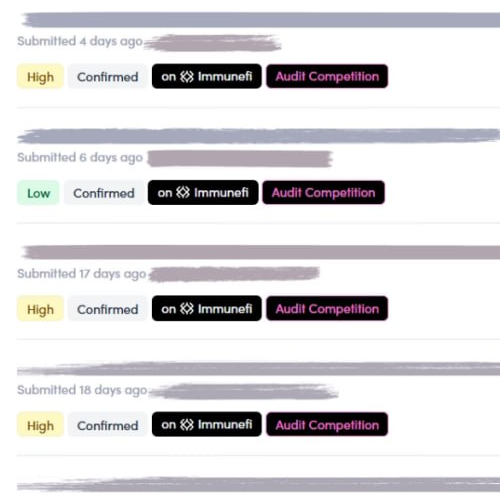
Immunefi independently documents the competition scope and proof requirement. The four-row result comes from vigilX’s redacted activity image; its hidden account and report names prevent independent attribution. The image also omits attack paths, impact, and fixes. We keep those details out of the public claim.
We apply the same evidence standard to a scoped engagement: agree on attacker capabilities and a research window, then deliver a runnable reproducer, observed impact, and mitigation notes for confirmed findings.
DISCUSS A SCOPE ↗Autonomous search widens the search space. A verification gate narrows it to attacker-reachable paths with replayed impact.
Build import and call maps, identify attacker inputs, then give each investigation only the relevant code.
Run independent passes over the same targets, deduplicate repeated ideas, and rank the leads.
Check the cited code, data flow, guards, and external attacker reachability before investing in a proof.
Run a reproducer, repeat the result, and document observed impact for the engineering team.
A model output is a lead, not a finding. We require a runnable reproducer and replayed impact before handoff.
Jeremyah’s published article explains scoped code context, parallel investigations, retries, and verification gates. Its benchmark examples are author-reported.
READ JEREMYAH’S ARTICLE ↗A separate redacted Immunefi image shows ten Paid entries across bug bounties and audit competitions. Its capture date is not shown.
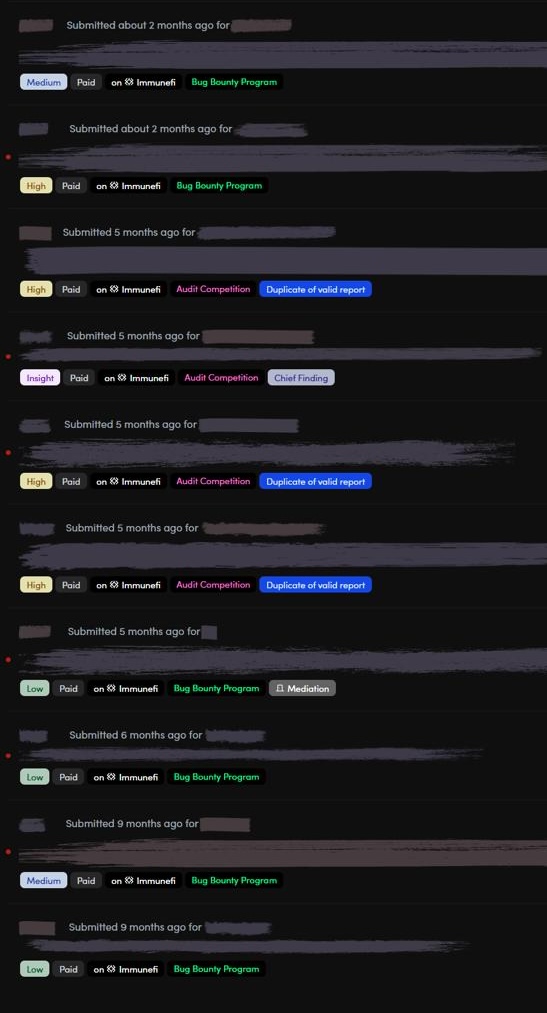
The image labels all ten rows Paid. The list transcribes their visible severity, venue, and outcome labels; it does not imply ten unique confirmed bugs.
Start with three things: the system or repository, release milestone, and constraints. We return a written scope with the target, attacker model, research window, and evidence standard.
Share the technical brief and name the failure that would put the release at risk.
Review the proposed target, attacker model, research window, and evidence standard.
Confirmed findings come with a runnable reproducer, observed impact, and mitigation notes.
A short technical note is enough to begin. Include any trust boundary you especially want challenged.